We’ve been asked this question many times—by friends, colleagues, and industry professionals—and thought it was time to publish something about it.
About ten years ago, we began noticing a trend: large enterprises were consistently building their own middleware between their content management systems (CMS) and translation management systems (TMS). One enterprise even issued a request for proposal (RFP) for such a system, which we won. This revealed a clear necessity for this type of solution, and its importance has become even more apparent in recent years.
So, why would large enterprises need such a system if they already have a TMS? What exactly does this system offer them?
Large enterprises often utilize multiple CMSs. Unfortunately, some are not designed with localization in mind, others are not ready for localization, and some are homegrown. Additionally, most large enterprises customize their CMSs, making out-of-the-box CMS-TMS integrations insufficient for their needs. As a result, these enterprises often struggle with integrations that are either broken or non-existent. Moreover, many stakeholders involved in the localization process—such as requesters, content managers, developers, program managers, and quality assurance managers—do not work directly in the TMS. Consequently, they lack a way to automate and coordinate their work, leading localization project managers (LPMs) to rely on makeshift solutions like spreadsheets, generic project management tools, and off-the-shelf service management systems to manage their translation requests. Unfortunately, these tools were never designed with localization in mind. Such ad-hoc implementations often lack essential integrations and workflow automation, resulting in manual and incomplete solutions that fail to scale alongside the increasing volume of localization requests. Over time, the localization process struggles as the number of stakeholders and CMSs increases, leaving the localization department to constantly fight fires and stakeholders increasingly agitated. At this point, enterprises recognize the necessity for change.
Some enterprises try to develop their own translation platforms in-house. While some localization departments possess the resources to build these systems, this is often the exception, primarily due to the steep costs of maintaining an experienced engineering team with localization expertise. Others turn to their IT or tools/productivity teams, who are usually not familiar with the complexities of the localization process and CMS-TMS integrations. These internally developed systems can take many months—and, in some cases, years—to develop and launch, even under the best circumstances. Furthermore, while creating a new tool may be enjoyable, maintaining and improving it is a different story. Some localization departments eventually find themselves being constrained by the system builders, who don’t fully understand their needs and are not assigned to the project long-term. And most of us in localization don’t get to tell IT what work to do.
Does this situation sound familiar? Have you faced similar challenges? If so, we invite you to learn more about Spartan and our flagship application, Argo.
About Spartan
Spartan Software, Inc. (“Spartan”) was founded in San Francisco in 2008. The company initially operated as a custom software developer for enterprise localization departments. In the early years, we developed various CMS-TMS integrations, TMS-MT (machine translation) integrations, and TMS-TD (terminology database) integrations. Additionally, we created applications such as a project management system for MT systems, a Linguistic Quality Evaluation (LQE) application integrated with a TMS, a localization project accounting system, and an asset management system.
By 2014, we recognized the need for a hub-and-spoke middleware to connect these systems. There was also a noticeable absence of a commercial project management system designed specifically for enterprise localization. In response to these challenges, we began developing a proprietary localization request management system. This system, known as Argo, has served as the foundational tool for building localization platforms for our customers since 2018. Today, Argo efficiently manages and automates complex localization processes for our customers.
Localization Request Management: Is That Even a Thing?
Argo refers to a translation service request as a “request” instead of a “project” because a request is exactly that: it is an “ask” that does not always turn into a project, which is a unit of committed work. Sometimes, requests are not even ready to be ingested by the TMS, and the localization project managers may choose not to send them there.
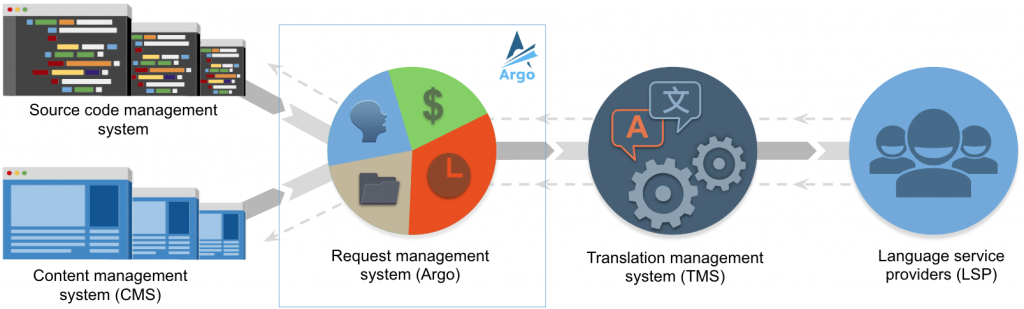
Conceptually, users or systems initiate translation requests, localization project managers manage these requests in Argo, and language service providers (LSPs) manage the translation projects in the TMS. In this model, all parties work in systems specifically designed for their roles. For example, Argo is not intended to be used directly by linguists.
About Argo
Argo, developed by Spartan Software, Inc., is a localization request management system offering a comprehensive suite of tools for integration, automation, and collaboration tailored to the complex needs of enterprise localization teams. With extensive API support, Argo has been integrated with a wide variety of content management systems (CMS) and translation management systems (TMS), and customers have built their own integrations with Argo. Moreover, Argo can be configured to work with multiple TMSs or language technologies in parallel, offering valuable flexibility to our customers. You can see some of our customer testimonials on our website.
Argo is NOT a translation management system (TMS). It does not have filters, translation memory, a terminology database, a translation workbench, etc. We have no intention of turning Argo into a TMS. In fact, one of our objectives is to be a good partner to TMS providers.
My team and I are excited about the request management and integration aspects of the localization process. You can reach out to us at hello@spartansoftwareinc.com or connect with me on LinkedIn if you would like to learn more about Spartan and/or Argo.
Thank you for reading this article!